 Coinmarketcap
 Coinmarketcap portfolio tracks holdings through transaction records and connected balances
Coinmarketcap portfolio tracks crypto holdings from manual transactions, public wallet addresses or supported exchange connections. It uses market prices to value recorded quantities and purchase records to calculate performance. Acquisition prices and recorded fees determine whether those gains reflect actual purchase costs. Adding holdings creates a tracking record without transferring custody of the underlying assets.
· updatedA correct balance and a complete profit calculation require different information. Quantities support valuation; transaction history explains acquisition costs and sales. With only an incoming transfer in an asset’s history, its full market value can appear as unrealized profit.
How do I record a holding with its original purchase cost?
Within a signed-in account, a manual Buy entry records the acquired quantity, actual purchase price, date, time and transaction fees. Missing purchase details leave acquisition costs unresolved even when the quantity is correct.
Consider a saved holding whose quantity matches the assets held elsewhere, while its reported gain looks unexpectedly high. A complete Buy entry should match the original trade record’s quantity, unit price, purchase time and fees. Opening the transaction details allows a comparison with the original trade record before changing anything.
- When a purchase record exists, match the saved quantity and unit price to that record.
- When the transaction incurred fees, enter the fee amount separately from the unit price.
- When the holding arrived through a transfer, establish whether its original purchase history is also present.
- When a connection already tracks the holding, check for overlapping manual entries.
- When the acquisition cost remains unknown, interpret the balance separately from the reported profit.
An incorrect manual field can be edited in the transaction details without changing assets held elsewhere. After correction, the saved entry should match the acquisition record and the holdings list should show the intended quantity. If the original cost remains unavailable, an invented purchase price would create an artificial return.
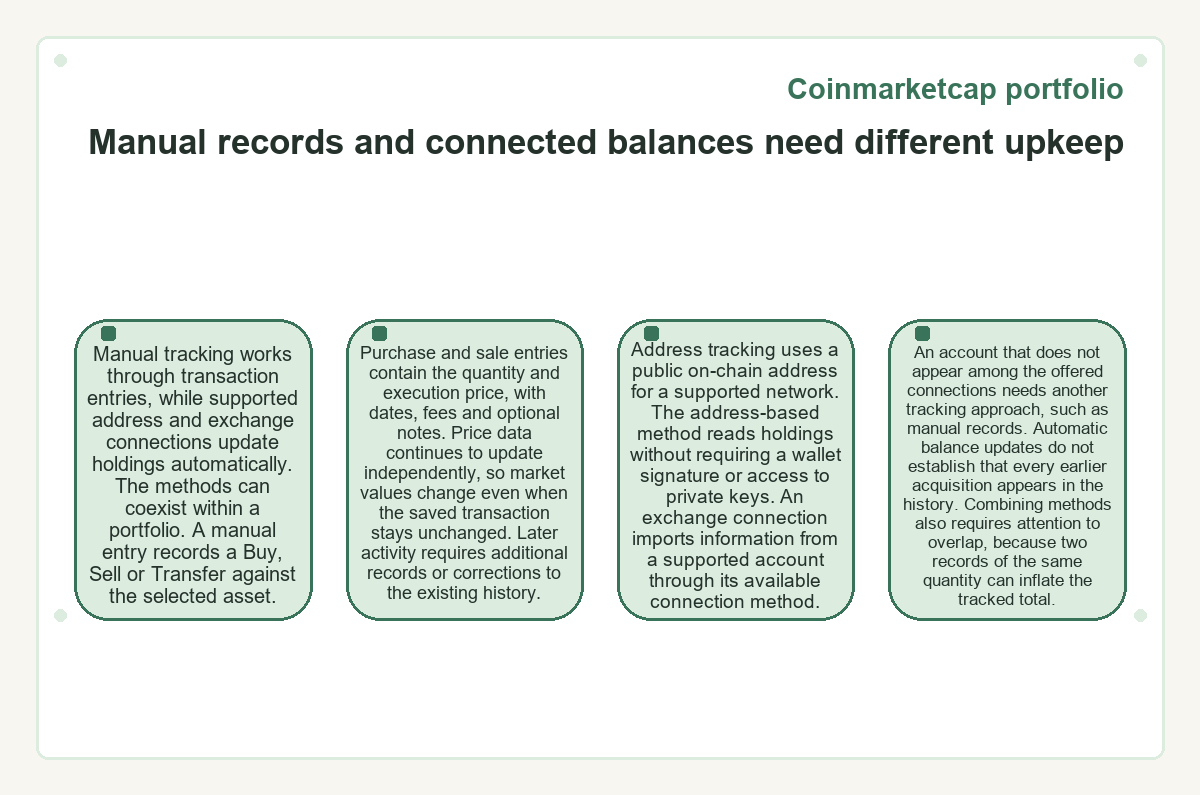
Manual records and connected balances need different upkeep
Manual tracking works through transaction entries, while supported address and exchange connections update holdings automatically. The methods can coexist within a portfolio.
A manual entry records a Buy, Sell or Transfer against the selected asset. Purchase and sale entries contain the quantity and execution price, with dates, fees and optional notes. Price data continues to update independently, so market values change even when the saved transaction stays unchanged. Later activity requires additional records or corrections to the existing history.
Address tracking uses a public on-chain address for a supported network. The address-based method reads holdings without requiring a wallet signature or access to private keys.
An exchange connection imports information from a supported account through its available connection method. An account that does not appear among the offered connections needs another tracking approach, such as manual records. Automatic balance updates do not establish that every earlier acquisition appears in the history. Combining methods also requires attention to overlap, because two records of the same quantity can inflate the tracked total.
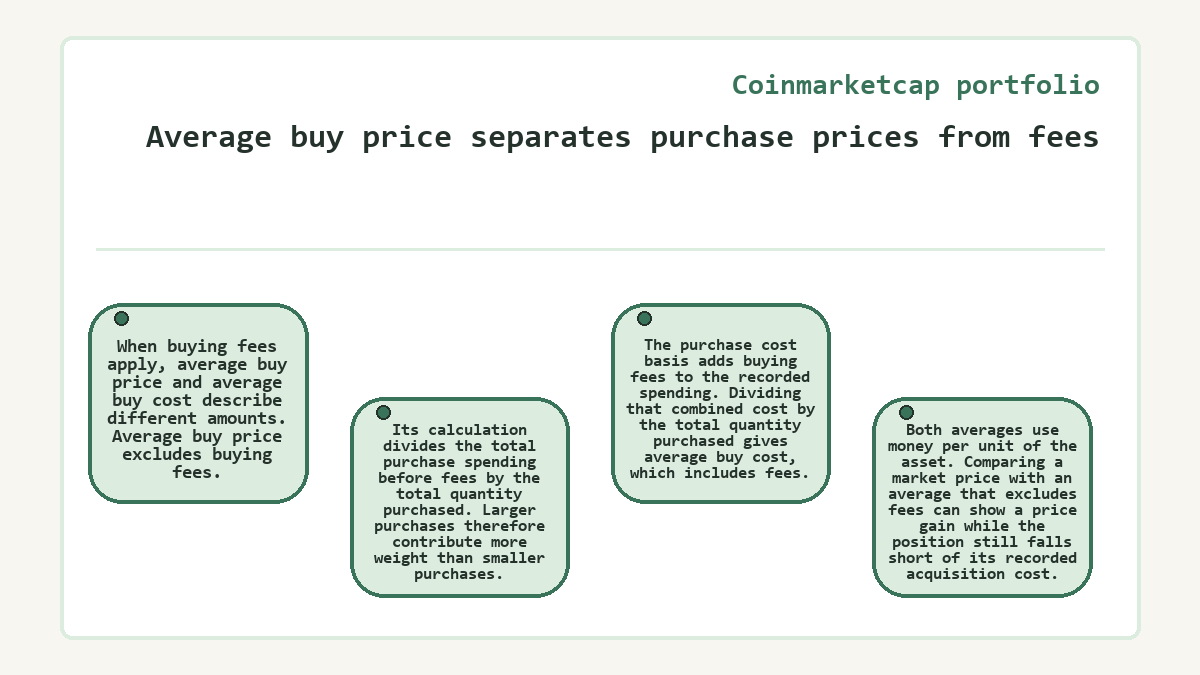
Average buy price separates purchase prices from fees
When buying fees apply, average buy price and average buy cost describe different amounts. Average buy price excludes buying fees. Its calculation divides the total purchase spending before fees by the total quantity purchased. Larger purchases therefore contribute more weight than smaller purchases. The purchase cost basis adds buying fees to the recorded spending. Dividing that combined cost by the total quantity purchased gives average buy cost, which includes fees. Both averages use money per unit of the asset. Comparing a market price with an average that excludes fees can show a price gain while the position still falls short of its recorded acquisition cost.
Sales divide performance into realized and unrealized gains
Once a sale enters the history, the tracker distinguishes the gain on the sold quantity from the changing value of remaining holdings. Realized profit concerns completed sales; unrealized profit concerns assets still held.
For sold units, the calculation subtracts their allocated purchase cost and selling fees from the recorded proceeds. For remaining units, it compares market value with their allocated purchase cost.

All-time profit combines realized and unrealized results. A positive realized result can coexist with a negative unrealized result, so the combined figure can conceal their different contributions. The profit percentage relates the combined result to recorded purchase cost basis. Missing purchase costs can consequently affect both the gain and its percentage.
Unrealized gains change with prices even when the quantity stays fixed. Recording a sale reduces the remaining quantity, while its realized result stays in the performance history. A portfolio balance therefore cannot replace a profit figure: one values remaining holdings, and the other also accounts for completed sales.
Transfers change holdings without recreating purchase history
A manual Transfer entry records assets entering or leaving the tracked portfolio without requiring a purchase price. Transfer in increases the recorded quantity, while transfer out reduces it. A movement between locations that you control differs from selling the asset. Entering that movement as a sale would introduce sale proceeds that the movement never produced.
The original purchase cost belongs to the acquisition history. An incoming quantity alone does not establish what you originally paid, including associated fees. A portfolio containing transfer entries can consequently have a meaningful current valuation and an incomplete acquisition record. Missing purchases can prevent the reported return from representing the full investment history.
The displayed balance values recorded holdings
For each holding, the tracker multiplies the recorded quantity by its market price to estimate its current value. Adding those values gives the portfolio balance in the selected display currency. Quantity measures units of an asset; balance measures their monetary value. A price change can therefore alter the balance without changing how many units the record contains. The short-term price-change column describes market movement over its displayed window. It does not measure the return on your purchase, which depends on your cost and recorded fees.
Recording a transaction in the portfolio does not execute an asset trade. The Buy and Sell labels identify bookkeeping entries. They describe activity that happened elsewhere, and changing a manual entry changes the record. The displayed balance represents tracked information rather than funds that the portfolio holds for withdrawal.
Allocation and balance charts follow different changes
Allocation expresses each holding’s current value as a share of the tracked portfolio total. Relative price changes can alter those shares even when quantities remain constant. Balance charts show recorded value over time, which also responds to transactions that change holdings. A rising balance line can reflect additional assets as well as market gains. Reading allocation alongside the transaction history separates changing portfolio composition from a change in the price of an existing holding.
Transaction dates preserve the history behind returns
Historical entries need the actual transaction date and execution price to describe the purchase that occurred. A market quote viewed today cannot establish an earlier trade’s cost. The date places the quantity change in the portfolio’s timeline, while the unit price supplies its acquisition value. Historical market snapshots describe past market conditions, not an individual holding’s acquisition terms or fees. An incorrect date can alter the apparent sequence of holdings changes even when the total quantity looks right. Separating the trade timestamp from the time that someone entered the record keeps later comparisons meaningful.
Account sync shares records and privacy mode hides values
The web interface and mobile apps synchronize portfolio records through the same account. Portfolio access exists on iOS and Android, so changing devices does not require recreating every manual transaction. Records belong to the account that saved them. Selecting the intended portfolio also keeps its entries separate from other portfolios within that account.
Privacy mode hides displayed balances and holding values from view. That screen setting does not erase transaction records or prevent account access. Public-address tracking associates the monitored address with the account that saves it. Manual transaction tracking can omit wallet addresses and wallet credentials when transaction records supply the necessary holding information.
Worth knowing
Does the portfolio tracker require a paid subscription?
The portfolio tracker is free to use with an account. Tracking access is separate from the costs of acquiring or selling the assets that you record. A transaction fee entered into the portfolio describes that outside activity; it is not a subscription charge for maintaining the tracking record.
Can transaction notes identify where a holding is stored?
Transaction notes can record the location associated with a purchase or holding. They provide a reminder alongside the transaction details, such as which account contains the assets. A note does not connect that account or establish that the assets remain there after later transfers. Its information needs to remain consistent with the transaction history.
Will removing an asset from the portfolio sell its coins?
Removing an asset removes its records from the tracked portfolio without selling the underlying coins. The coins remain in the wallet or exchange account where they actually reside. Removal can change the displayed balance and performance history, so it has a bookkeeping effect even though it does not execute a trade.
Why can charts lag behind a saved transaction edit?
Historical balance and allocation charts may need time to recalculate after a transaction edit. A saved correction and a rebuilt historical chart need not appear together immediately. Further duplicate entries can introduce another error, so a chart that has not yet reflected an edit is not evidence that the original transaction needs adding again.
Do portfolio gains provide the cost basis needed for a tax return?
The portfolio’s profit calculation does not by itself establish the cost basis required by applicable tax rules. Its average-cost calculation describes tracked performance. Tax reporting can require different transaction treatment and additional records, including receipts, disposals and fees. The original transaction history remains relevant even when the portfolio displays a clear gain or loss.
Is a portfolio screenshot evidence that someone controls the assets?
A portfolio screenshot does not establish ownership or control of the displayed assets. Manual quantities and purchase prices can produce convincing balances and profit figures without proving that corresponding holdings exist. A connected public address also does not prove that the person presenting the screenshot can spend from it. The image alone cannot substantiate an investment return.
Why can an exchange valuation differ from the portfolio value?
An exchange valuation can use a different price from the market reference used by the portfolio. Prices vary between trading venues, and data updates can arrive at different times. Display currencies can also differ. The recorded quantity, asset identity, currency and price timestamp determine whether the two monetary values describe comparable holdings.
Can I maintain separate portfolios without moving any funds?
Multiple portfolios let you organize separate tracking records on desktop and mobile without transferring the underlying assets. Each portfolio represents the holdings recorded within it. Recording the same quantity in several portfolios does not create additional coins, and adding their balances together can overstate the amount that you actually hold.